Why Good People Get Overlooked: Resume Mistakes That Make Hiring Managers Move On
Sometimes highly qualified people get passed over before anyone even learns how capable they are.
Why? Because their resume makes it too hard to quickly see their value.
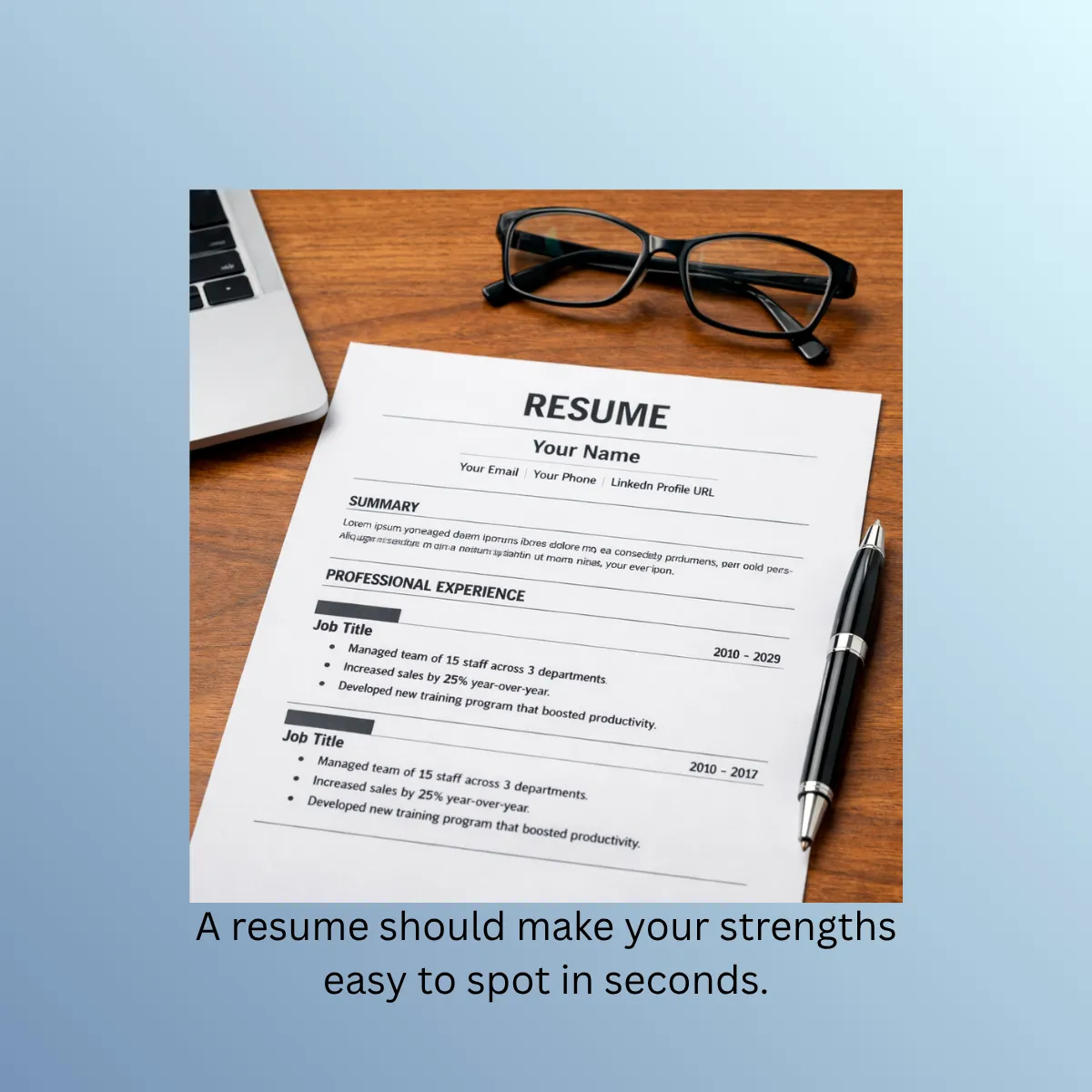
Hiring managers often spend only a short time scanning a resume on the first pass. That means a resume is not simply a record of where you have worked. It should be a document designed to make key strengths easy to spot in seconds.
And yet, many resumes do the opposite.
One of the most common mistakes I see is people trying so hard to force everything onto one page that the result becomes cramped, crowded, and difficult to read.
A second page is not a failure. In many cases, it is the better choice.
Stop Forcing Everything onto One Page
A one-page resume can work well early in a career, but after years of experience, squeezing everything into a single page often hurts more than it helps.
Tiny font, narrow margins, crowded bullet points, and compressed spacing make important accomplishments disappear. This may also cause your very valuable contact information to be much smaller than it should be.
If moving to two pages allows your strongest experience to breathe and become easier to scan, do it. The key is this: only use a second page if you have enough meaningful content to fill at least two-thirds of it. A second page with only a few extra lines can look unfinished. But a well-used second page often gives your experience the clarity it deserves.
Once you are at the point in your career where you have held many different positions, you will want to eliminate the oldest ones. If a previous role from many years ago will help spotlight specific skills you will need for a role you are applying for, include it even if there is a gap in your dates of employment. Your resume is meant to highlight the skills you can bring to a potential employer – not to list every job you have had since you started working.
Put the Spotlight Where It Belongs
Many resumes lead with the employer name in large bold print and tuck the actual job title underneath. That puts the attention in the wrong place.
In most cases, your job title is what deserves immediate emphasis. Bold your title first, then list the employer.
You are usually trying to highlight what you did, not simply where you did it (unless the company name itself carries special weight).
For example:
Director of Operations
ABC Company
That instantly tells the reader what level of responsibility you held.
Make Dates Easy to Find
Hiring managers often look quickly to understand career progression and current employment. Right-justifying dates of employment helps them scan your timeline immediately.
It becomes especially useful when someone currently holds more than one role, because readers can quickly understand what is ongoing and what has ended. A clean layout helps your experience tell its story faster.
Bullets Should Start with Action
A resume should not read like a job description copied from an HR file.
Each bullet should begin with a strong action verb:
Led (The past tense of lead IS NOT lead! This is one of the most common mistakes I see.)
Managed
Created
Increased
Launched
Improved
Coordinated
In your current position, most action verbs will be present tense, but for one-off tasks you may use past tense for that bullet in your current role. All previous job descriptions should start with past tense action verbs.
All bullet point descriptions should be written with the “I” subject understood, so the verbs used should agree with an “I” subject.
Correct:
·Coordinate and run weekly team meetings
Incorrect:
·Coordinates and runs weekly team meetings
Smaller words like “the” and “a” may be left out of bullet descriptions to make room for more important details. The bullets are phrases, not sentences, so no periods are needed at the end.
Use Numbers Wherever Possible
Numbers immediately catch the eye.
They also make claims feel concrete.
Instead of writing:
Managed staff responsibilities
Write:
Supervised 12 employees across 3 departments
Instead of:
Helped improve sales
Write:
Increased sales 18% in one fiscal year
And in resumes, let the numerals do the work.
Use:
5 employees
22% increase
$350,000 budget
Not spelled-out versions.
You are not writing formal prose—you are helping results stand out visually.
Experience Usually Comes Before Education
Unless you recently graduated or your education is your strongest selling point, your work experience should come first.
Employers usually care most about what you have done recently and how that connects to the job you want now. Education still matters but often belongs lower on the page(s).
Formatting Is Not Decoration. It Is Strategy.
A resume should guide the eye.
That means:
consistent spacing
clean alignment
readable font
enough white space
consistent bullet style
Dense paragraphs make readers work too hard.
A resume should feel easy to move through because if it feels difficult, many people simply stop reading.
Tailor, Don’t Send the Same Resume Everywhere
One strong resume often needs slight adjustments depending on the role.
That does not mean rewriting everything each time. It means emphasizing the most relevant strengths for that opportunity.
If leadership matters most, move leadership accomplishments higher. If communication matters most, make those examples easier to see.
The strongest resume is not always the longest one. It is the one that makes the right things obvious quickly.
Don’t Let AI Flatten Your Voice
Artificial intelligence can help generate ideas, improve wording, or suggest structure – but many resumes now sound strangely alike because too much AI language is left untouched.
Hiring managers are increasingly seeing resumes filled with polished phrases that sound impressive but say very little.
Words like:
results-driven
dynamic professional
proven track record
strategic thinker
appear so often that they no longer help a candidate stand out.
A stronger resume sounds like a real person describing real work.
Instead of broad claims, use specifics that only you can say:
what you improved
what you solved
what changed because you were there
what skills you will bring to this job
AI can help polish, but it should never erase your own voice or replace actual accomplishments.
A resume should sound like you on your best professional day, not like everyone else using the same software. When a hiring manager reads three resumes in a row that sound nearly identical, authenticity becomes memorable.
Your Resume Should Make Someone Want to Meet You
A resume does not need to tell your entire story.
It only needs to do one important job:
Make someone interested enough to invite you to the next conversation.
Clarity wins. Readable wins. Well-organized wins.
Often, the people with the strongest backgrounds are the ones hiding their value simply because they are trying too hard to fit everything into old rules that no longer serve them.
Until next time, keep leading with passion and purpose. 💌
Have a question or want to share your thoughts? Email me at [email protected]. I’d love to hear from you.
For resume help, please visit www.reviseresume.com, and for nonprofit assistance, visit www.501guide.com.